Limestone, black clay and why trees fail here
Drive across Georgetown on Highway 29 and you cross from Hill Country rock into Blackland Prairie clay in a couple of miles. The trees on either side die for different reasons — and both of them look like something else.
Two kinds of ground, one city
The Balcones Escarpment — the fault line that separates the Hill Country from the Blackland Prairie — runs through Williamson County roughly along I-35. West of it, in Sun City, Berry Creek, Wolf Ranch, Serenada and out toward Liberty Hill and Andice, the ground is Edwards and Glen Rose limestone with a few inches to a couple of feet of thin, rocky caliche soil on top. East of it, in Old Town, San Gabriel Park, Teravista and out through Hutto, Taylor, Weir and Walburg, it's Blackland Prairie — deep, black Houston clay that shrinks in August and swells in October. The Georgetown square sits almost exactly on the line. Which side your house is on tells our arborist half of what he needs to know before he looks at the tree.
West of the line: limestone
Shallow, wide roots
A live oak or post oak in a foot of soil over rock roots wide and shallow instead of deep. That's fine until a wet week saturates the thin layer and a March front pushes on a full canopy; the whole root plate levers up out of the rock. When you see a big tree lying flat with its roots in the air after a storm west of I-35, that's why.
Drought
Thin soil holds little water. The summers of 2011 and 2022–23 killed post oaks across the county, and post oaks die slowly — they lose the top of the crown the following year, thin for two or three years, and then go brittle. A post oak that looks half-dead this spring was hurt two summers ago.
Cedar
Ashe juniper takes every gap in the limestone, shades out the oak seedlings and pulls water from the same thin layer. Clearing it off a lot is usually the best thing that ever happened to the live oaks on it.
East of the line: black clay
Shrink and swell
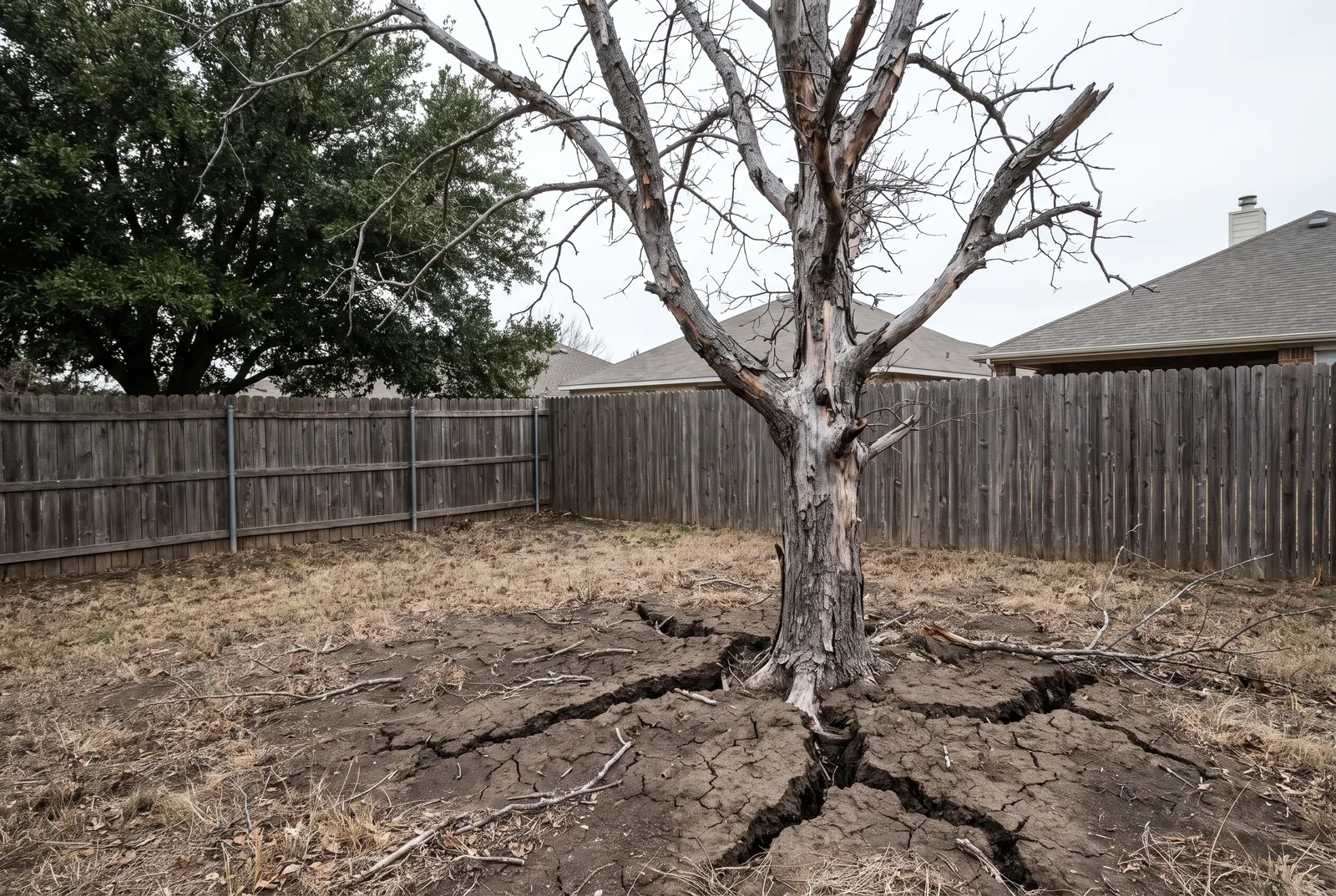
Houston Black clay is a vertisol — it can shrink and swell several inches between a dry August and a wet October. Every cycle snaps fine feeder roots and heaves the root plate. Trees that tolerate it (cedar elm, bur oak, pecan, chinquapin oak) do well; trees that don't (red oaks planted from the nursery, Arizona ash, most conifers) decline slowly and get blamed on something else.
Drainage
Black clay drains slowly. A low spot that stays wet for a week after a rain drowns roots, and a tree planted in a clay bowl dug into clay is sitting in a bathtub. Root rot and hypoxylon canker follow.
The river
The San Gabriel bottoms are the exception — deep alluvial soil that grows the biggest pecans and bald cypress in the county. The trade-off is flooding: the river comes up fast, undercuts the bank, and leaves big pecans leaning with their roots exposed.
What kills trees on both sides
Post oak decline
Post oaks are the most sensitive tree in Central Texas to anything that changes their root zone. Fill dirt over the roots, a new driveway, a trench for a water line, a sprinkler system, a lawn where there used to be leaf litter, or just two years of drought — and the tree begins to die from the top down. It takes two to five years, it can't be reversed once it's past a third of the crown, and dead post oak turns dangerously brittle within a year or two. Most of the dead post oaks we remove were killed by construction, and the homeowner was told it was a disease.
Construction damage
Georgetown built more houses in the last five years than in the previous twenty, and a lot of them went in inside the Critical Root Zone of a Heritage live oak. The city's code protects one foot of radius per inch of trunk from cutting, fill and compaction, but the damage often shows up three years after the builder is gone: thinning crown, dieback on the side nearest the slab, mushrooms at the base.
Grade changes and fill
Four inches of fill over a live oak's roots can kill it by cutting off oxygen. So can a new patio, a raised bed against the trunk, or a French drain cut through the root plate.
Oak wilt
Not a soil problem, but it moves through live oak root grafts — and root grafts are more extensive in the shallow limestone soils west of town, where the roots of a whole neighborhood's live oaks are tangled in the same foot of ground. See the oak wilt guide.
What to plant instead
West of I-35, on limestone: live oak, Texas red oak (Buckley oak), chinquapin oak, Lacey oak, cedar elm, Texas mountain laurel, escarpment black cherry, Mexican plum — the natives that already grow there. East of I-35, on clay: bur oak, chinquapin oak, cedar elm, pecan, Shumard oak, bald cypress in the low spots. Anywhere: not Bradford pear, not Arizona ash, not Chinese tallow, and not another post oak in a yard that just killed one.
Common questions
Why is my post oak dying from the top down?
Almost always root damage — construction, fill, a new lawn or sprinkler system, or drought — two to five years ago. Our arborist can tell you whether it's past saving; below a third of crown loss, deep watering and leaving the roots alone sometimes works.
Can I add soil around my live oak to level the yard?
Not more than an inch or two, and not against the trunk. Live oaks breathe through their surface roots; four inches of fill can kill a 100-year-old tree in three years.
Is my tree in the black clay or the limestone?
Dig a hole. If you hit rock in a foot and the soil is pale and crumbly, it's limestone. If it's black, sticky when wet and cracks open in August, it's Blackland clay. Roughly, west of I-35 is rock and east is clay, but the line wanders.
Why do the live oaks in my new subdivision look worse than the old ones in town?
Because the old ones grew up in undisturbed soil and the new ones had a house, a driveway and a compacted lawn built inside their root zones. Some recover; some don't. Water deeply, mulch wide, and keep the mower and the fill away from the roots.
Should I water my trees in the summer?
Yes — a slow, deep soak once every two or three weeks in July and August for established trees, more for anything planted in the last three years. It's the difference between a post oak surviving a 2023-style summer and not.
Related: Live oak & post oak care · Tree removal · Cedar & lot clearing · Oak wilt in Williamson County