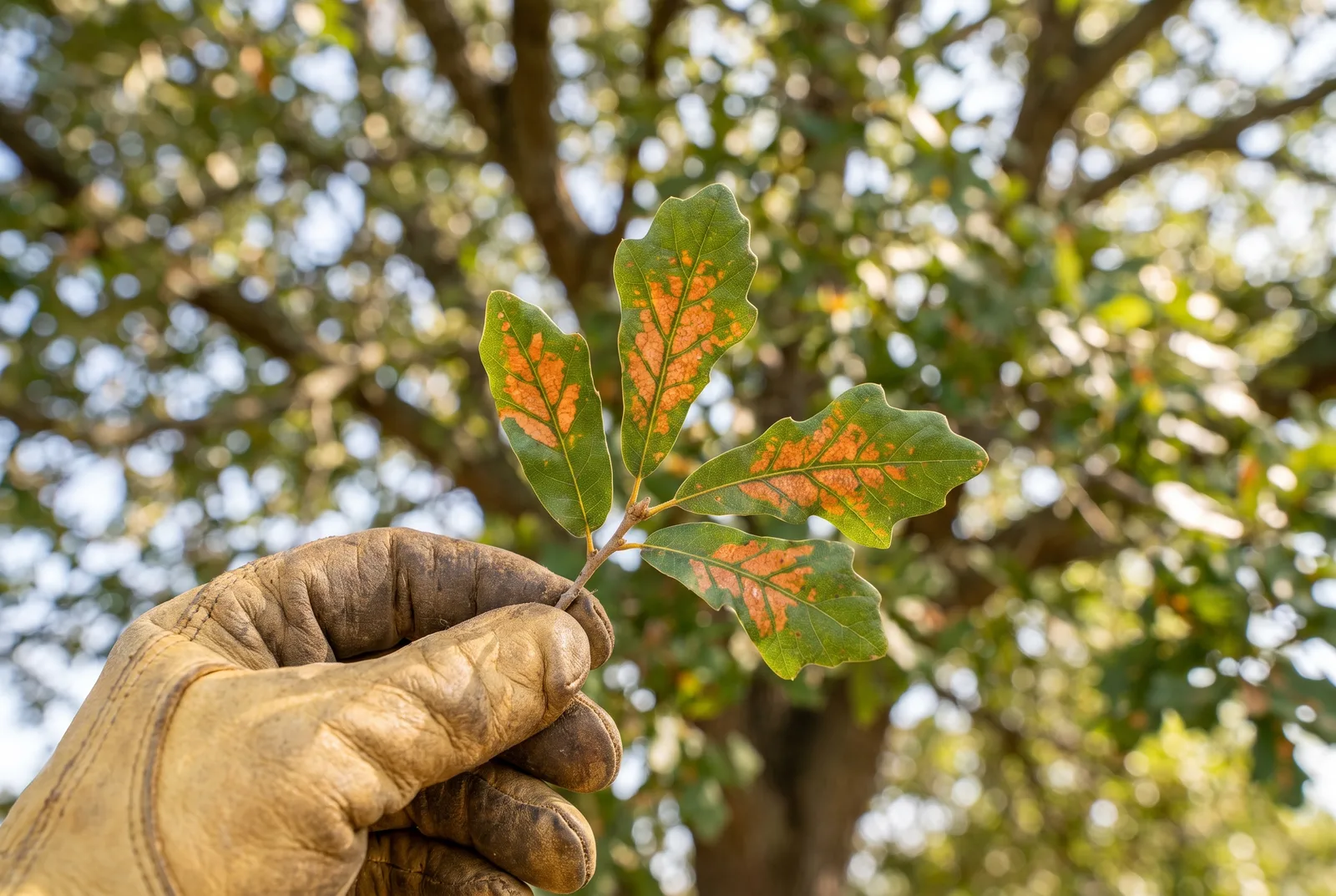
What oak wilt is
Oak wilt is a fungal disease — Bretziella fagacearum — that plugs the water-conducting vessels of oaks. It has killed more oaks in Central Texas than any other cause, and Williamson County sits squarely in the active zone. Red oaks (Texas red oak, Shumard oak, blackjack oak) die fast, usually within four to six weeks of showing symptoms. Live oaks die more slowly, over months to a couple of years, but they're the reason it spreads so far: their roots graft together underground, and the fungus travels from tree to tree through the grafts at roughly 75 feet a year.
How it spreads
Overland, by beetle
When a red oak dies of oak wilt, fungal mats can form under its bark the following cool, wet season. The mats smell like fruit and attract sap-feeding nitidulid beetles, which pick up spores and then feed on fresh wounds on healthy oaks — including pruning cuts. That's why the danger window is February through June: mats form on dying red oaks in the cool months and the beetles are flying. A fresh unpainted cut in April is an open door.
Underground, by roots
Once a live oak is infected, the fungus moves through root grafts to every connected live oak — which in a Georgetown neighborhood of old live oaks planted from the same motte can be every tree on the block. This is how a single infection center swallows a street over five years, and it's why trenching matters.
What it looks like
- Live oaks: veinal necrosis — the leaf veins turn yellow, then brown, while the tissue between them stays green for a while. It's the most reliable symptom in Central Texas and it's what our arborist looks for first. Leaves drop; the crown thins from the outside in.
- Red oaks: leaves wilt and turn pale green then bronze from the edges, starting at the top of the tree, and the whole crown goes in weeks. Dead red oaks are the ones that can grow fungal mats, so they need to come down and be chipped or burned promptly.
- Not oak wilt: a live oak that drops a lot of leaves in March is doing what live oaks do every spring. Drought stress, hypoxylon canker and root damage from construction all get called oak wilt. Get it looked at before you panic — or before you cut.
The rules we work by
- No oak pruning February through June. We schedule oak work from July through January. The hottest weeks of July and August and the cold months of December and January are the safest.
- Paint every oak cut immediately. Any month, any cut, storm damage included — a thin coat of pruning sealer or latex paint within minutes. This is the one time an arborist will tell you to paint a wound.
- Sterilize tools between trees. Saws, pole pruners, hand pruners.
- Handle infected wood carefully. Red oak from an oak wilt tree gets chipped, burned, or covered with clear plastic sealed to the ground until spring. Don't stack it for firewood next to healthy oaks.
Treatment and containment
Trenching
A trench at least four feet deep — deeper where the roots go deeper — cut around an infection center severs the root grafts and stops the underground spread. It has to go outside the last symptomatic tree by a margin of about 100 feet to get ahead of the fungus, and in a subdivision that means neighbors cooperating and a rock saw for limestone. We coordinate the trenching contractor; the trench is priced by the foot.
Fungicide injection
Propiconazole injected into the root flare can protect a healthy live oak near an infection center and sometimes save a live oak in the early stages. It doesn't cure a symptomatic tree and it doesn't work on red oaks. It's most worth it for a big Heritage live oak that shades the house and sits in the path of the disease.
Removal
Dying red oaks come out fast, before mats form. Dead live oaks come out when they become hazards. Either one, if it's a Heritage Tree, owes no mitigation — a dead or fatally diseased tree is exempt under UDC 8.02.030.D — and our arborist's letter is the paperwork.
If it's next door
Have your live oaks evaluated now, not after they show symptoms. Find out where the infection center's edge is. Talk to the neighbors about a shared trench; the county Extension office (512-943-3300) and Texas A&M Forest Service both help with cost-share programs and will confirm a diagnosis. Inject the trees worth saving. And stop anyone from pruning any oak on the block until July.
Common questions
Can I prune my oaks in the summer heat?
Yes — July through September is inside the safe window; the beetles aren't active and mats don't form in the heat. Paint the cuts anyway.
What paint do you use?
Any latex paint or commercial pruning sealer, applied within minutes. The product doesn't matter; the timing does.
My live oak dropped its leaves in March — is that oak wilt?
Probably not. Live oaks shed their old leaves every spring as the new ones push. Oak wilt shows as veinal necrosis — brown veins on a green leaf — and a crown that thins from the outside. Send us a photo of a leaf.
Is there a test?
Yes. A sample from a symptomatic branch goes to the Texas Plant Disease Diagnostic Lab in College Station; results take a week or two. Our arborist collects and submits it.
Do I owe mitigation if my Heritage live oak died of oak wilt?
No. A dead or fatally diseased tree confirmed by a certified arborist is exempt from mitigation under the Georgetown UDC. You still need the permit for a Heritage Tree, and our letter goes with it.
Related: Oak wilt evaluation · Live oak & post oak care · Tree trimming · Tree removal